 Rovelanto
How to specify a replacement cat cave insert
Build a replacement insert program around measured fit, revision control, clear compatibility, and a serviceable retail listing.
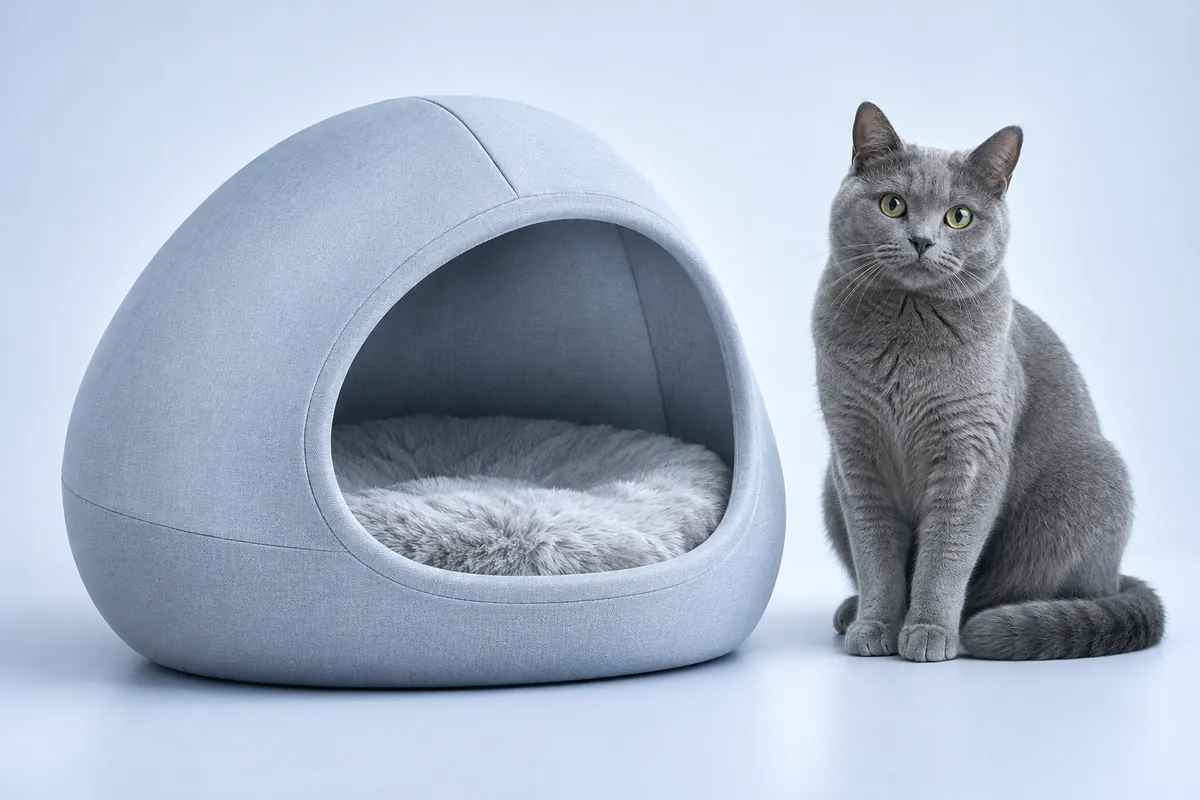 Illustrative collection concept
Give the insert its own part number and approve it against the oldest and newest bodies it is advertised to fit.
Start with the part the customer can replace
A removable insert is only a practical spare if a customer can identify it, order it, and fit it without guessing. Define whether the spare is a complete cushion, a cover alone, or both. Name the cave models and revisions it is meant to fit. Include the insert in the initial development brief: the first production run is a good time to confirm which dimensions and attachment features you can hold consistently.
Treat a spare as its own SKU with a bill of materials, pack format, and replacement instructions. If the shell changes later, check whether the old insert still fits before carrying its compatibility claims into a new listing.
Measure the interface
Measure the finished inner floor at the front and back, the narrowest entrance, corner shape, and any retention tabs. Record whether dimensions are taken with the cave fully assembled or laid flat. For the insert, capture relaxed length, width, depth, and the direction it passes through the opening. A cushion that fits the floor drawing can still be awkward to install if its edge has to pass a narrow entrance.
| Interface | Evidence to keep |
|---|---|
| Inner footprint | Measurements and photos with the body assembled |
| Entrance | Narrowest clear opening and intended insertion direction |
| Retention | Position and orientation of each approved attachment |
| Edge fit | Photos showing wrinkles, gaps, or lifted corners |
Worked example: one body, two cushion revisions
Suppose a retailer has an original cave and a revised body with a narrower opening. The original cushion inserts with a small bend; the new cushion uses a deeper fill. Try the new cushion in both bodies before using one spare listing. If it seats neatly in the old body but must be sharply folded to fit the new opening, check whether the folding changes its shape or loosens the stitching.
One solution is a shared shallower insert. Another is two clearly labeled spares. The decision depends on the approved fit and the cost of managing two lines, not on whether the nominal floor sizes match.
Put the spare through a service trial
Give a reviewer the retail instructions, the spare, and a representative body. Ask them to identify the right part, remove the old insert, and refit the new one. Repeat the fit check after the approved care trial and when the parts are fully dry. Record which body and cushion revisions were used. If any fastening or exposed component changes, have the revised construction reviewed before you release it.
- Confirm the spare part number appears on the retail pack and listing.
- Include a simple photo showing where to find the cave model identifier.
- Hold a reference sample of every body revision in the compatibility statement.
Plan the first reorder
Ask your supplier to quote spare packs separately from complete caves. Record whether the fabric, fill, and attachment parts can be reordered independently, and what changes would trigger a new approval. Track returns by body revision and by fit complaint. A spare that reduces a common replacement problem has a business case; one that creates compatibility disputes may be better sold alongside a smaller, clearly named range.
General product-development guidance. Confirm the selected construction, test scope and destination-market requirements for your project.
Editorial policy