 Rovelanto
How to run a pet-bed cover wash trial
Check dimensional change, closure alignment and refitting before approving care instructions for a removable pet-bed cover.
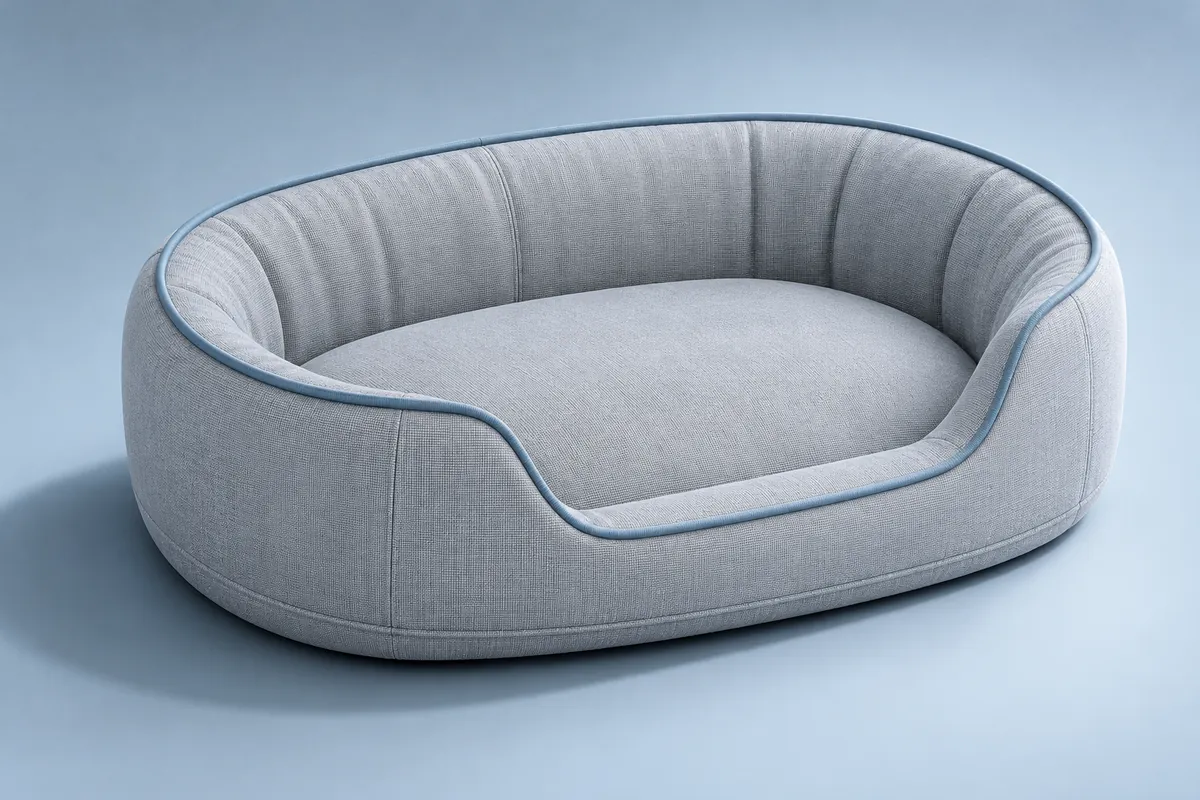 Illustrative collection concept
Approve a cover only after it fits the same insert after cleaning and meets agreed handling and appearance criteria.
Set the acceptance criteria first
The buyer needs to know whether a customer can put the clean cover back on the bed. Record the proposed care wording, the exact cover revision and the insert used for the check. If the insert is excluded from the wash procedure, retain it unchanged between the before and after checks. Record key seam lengths, zip opening and overall dimensions before cleaning. Use repeatable landmarks such as corner seams and avoid stretching the fabric to reach a ruler.
Agree how much change is acceptable at each point and which failures would stop approval. The most important limits may be local. A cover can meet its overall length requirement and still fail when the opening is too short to clear a thick bolster.
Run the proposed care process
Separate the cover from the insert as the customer would. Record cycle, temperature, drying approach and the number of cycles completed. Follow the proposed care wording instead of substituting an easier process midway through the trial. To compare two care options, use separate samples and label them. Measure again after the cover reaches the agreed dry condition. Photograph the same seam and fastener positions under comparable lighting. Record at each agreed checkpoint so gradual movement is visible.
| Check | Record before and after | Stop and investigate if |
|---|---|---|
| Cover dimensions | Seam-to-seam length and width at named points | The cover needs stretching to reach the approved shape |
| Opening | Usable zip opening with slider fully open | Insertion requires force or folds the insert |
| Assembly | Sequence to refit the same insert | One operator can assemble it only by finding a workaround |
Refit the bed as a customer would
Ask a reviewer to use the draft instructions without coaching. Watch where the cover grips or twists, whether the zip can be closed without pinching fabric and whether the insert returns to all corners. Lay the assembled bed on a flat surface and compare seam positions, wrinkles and any lift at the corners against the original sample. A tight zip may reflect the pattern, the laundry conditions or the insert tolerance. Document what happened before asking the supplier to propose a correction.
Make the follow-up sample answer one question
For example, if the clean cover fits along the sides but the bolster bunches near one corner, photograph that area and measure the opening and affected panel. Request a targeted pattern or opening revision, then repeat the same wash and refit check. An unwashed corrected cover does not resolve the original failure. Keep the final wash record with the care artwork and approved sample ID. If fabric, zip or sewing allowances change later, identify which parts of the trial need to be repeated. Record the result separately for any insert offered in the same cover size so the care wording stays tied to the assembly actually assessed.
General product-development guidance. Confirm the selected construction, test scope and destination-market requirements for your project.
Editorial policy