 Rovelanto
How to approve decoration on washable dog apparel
Compare print, embroidery and sewn labels on finished garments and check appearance and handling after the planned care process.
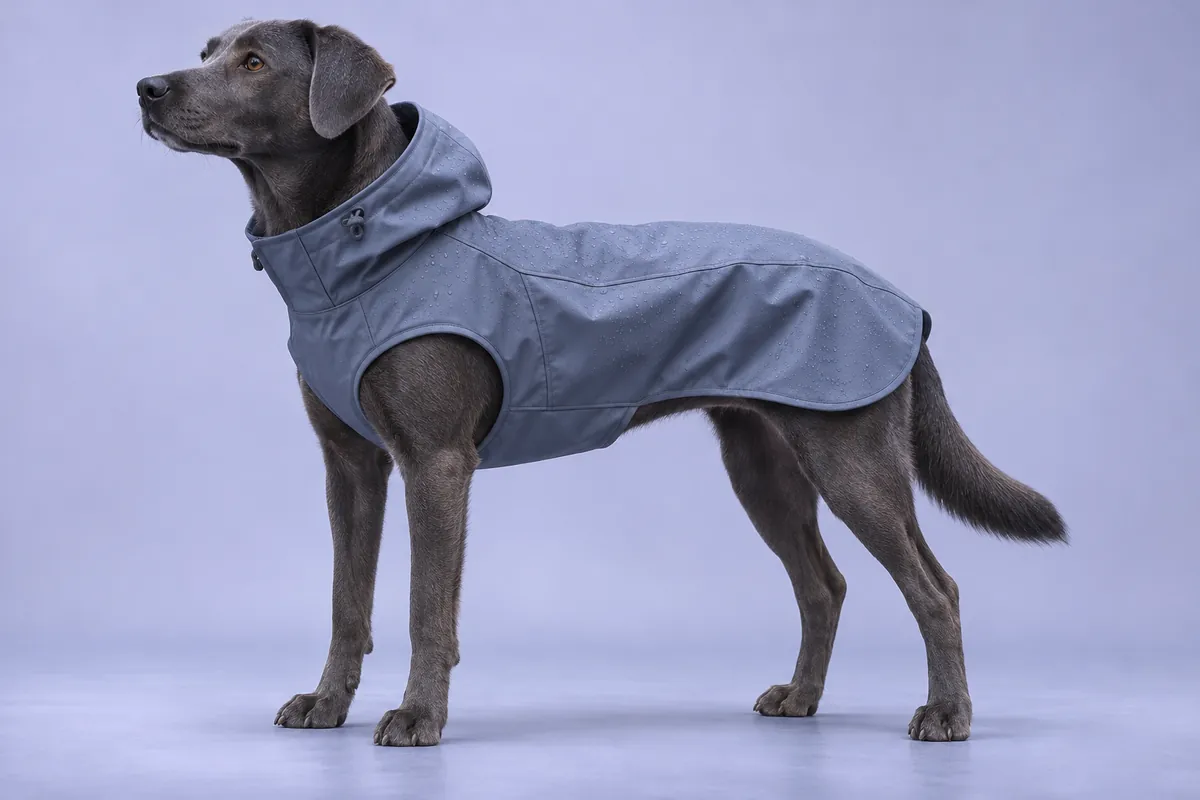 Illustrative collection concept
Approve decoration on the intended garment construction, then confirm that appearance and attachment still meet the brief after care.
Give the supplier a decoration specification
Send the artwork file, identify the decoration process and specify the finished dimensions. Place it relative to a seam or another consistent garment landmark. Ask whether the artwork dimensions will stay the same across sizes or scale. Record the fabric reference and decoration position together. A successful print on a flat swatch does not tell you whether the design will distort across a seam or sit too close to binding after assembly.
Agree the intended look, including what counts as unacceptable change. Record the colour reference and expected placement so a reviewer can compare a later production sample without searching the original email thread. If there is a named decoration reference, place that identifier on the sample tag too.
Review both the front and reverse
Check the garment in its relaxed state and intended fitted shape. For print, inspect artwork edges and alignment. For embroidery, inspect backing and loose ends. For a sewn label, check orientation, stitching and whether its edges are exposed at a contact point. Photograph the face and reverse under consistent lighting before care. If decoration is close to a seam or fastening, use the actual garment during approval and note any restrictions on position.
| Decoration | Evidence to collect | Buyer question |
|---|---|---|
| Close-ups before and after care; fitted view | Do edges and alignment still meet the brief? | |
| Embroidery | Face, reverse, backing and adjacent seam | Is the finish acceptable on both sides? |
| Sewn label | Position, orientation and edge finish | Is the label legible and attached as specified? |
Run care on the planned combination
Use the proposed garment care procedure, including the intended drying approach. Record the actual conditions and checkpoints. Recheck appearance, attachment and how the area behaves when handled as intended. Keep an undecorated control or original sample if you need to distinguish a fabric change from a decoration change. A pass on one fabric colour or construction does not establish a pass on every colourway. Identify which combinations need separate approval. A print-process name or thread name alone is not a record of the finished result.
Approve the correction as well as the artwork
A logo may look aligned before care yet show a visible wave next to a stretchy panel afterwards. Record the position and shape of the change and ask whether decoration dimensions, process or placement can be adjusted. Test the revised combination again. File the decoration proof with the garment sample ID, placement reference and care observations. Ask production to obtain approval before changing the process or artwork scale. If the decorated panel appears on multiple sizes, check the smallest relevant sample for usable clearance before signing off the range.
- For repeat orders, retain a dated sample made with the agreed production decoration materials and document who may approve substitutions.
General product-development guidance. Confirm the selected construction, test scope and destination-market requirements for your project.
Editorial policy